I hate who I have become. I feel like such foul company to live with. I feel like a vicious animal hiding in its cave, ready to bite someone’s head off if they come near it. My dad passed my room too many times today. When I went to leave he passed again, making me angrily thrust the sliding door shut and retreat. I just feel so shit all the time. Everything is so hard. Why does everything have to be so hard? I finally managed to fill out the form to have a stall at an upcoming afternoon market today, only to find I require some bloody Public Liability Insurance. It will probably cost me more than I earn at markets selling cheap badges. I want to bawl my eyes out but can never have a proper cry. My body hurts, my soul hurts. I have PMS on top of everything else. My dad chose the wrong day to approach me. He came in to ask if I wanted the bloody gardener who the NDIS covers to come tomorrow. The gardener’s meant to assist me, but he just gives me meltdowns with his loud machinery. My dad interrupted my addiction to the laptop. I wanted to scream at him. But at least we decided to call off the gardener, which I since regret as my tomato plants have not been growing and are drying up (maybe it’s just as simple as not watering them each day, though sadly my mum says it’s a bit late in the season to save them now). My dad came into my den a second time today to give me some corn. HISS. He put the bowl on my bed and I ignored him. I was sure he could feel the anger radiating out of me like heat from a fire.
I’ve been wearing my sister’s old childhood rash top to swim in, back from when she was a boy (my sister is trans). She secretly wanted to wear my clothes as a child, and I like wearing her’s. I still have some that got passed onto me, and I can still fit into them. I remember sometimes buying clothes from the boy’s section in kmart. Sadly the white vintage Piping Hot rash top has got some stains on it now which I can’t get out, and is all stretched too. While I can’t replace the nostalgia of having an item from childhood with our surname printed in black marker on the tag, I have been shopping around for a similar masculine or gender-neural rash top. Gender is something I haven’t talked about with many people. It is another reason why I miss Damien so much as he knew a bit about my gender identity. I remember telling him once I felt like “one of the boys”. He would have been happy to take me shopping for another boy’s rash top.
This post is going to be a bit about my gender identity. As I mentioned in one of my last few posts (yes, there’s been a few of them), I am gender fluid. I am generally pretty femme, get read as a girl and the people in my life continue to use “she” pronouns with me. I go to women’s full moon circles, trying to fill a hole in me as I did not fit in with other girls growing up, especially once I reached late primary school/high school, and was frequently bullied and excluded by them. I also don’t have the best relationship with my mum. A part of me does very much identity as lunarian, as it’s put in the perhaps overly complicated Galactian Alignment System. But what most people don’t know is that I also really like gender-neutral pronouns. I despise gender expectations, I am a female who doesn’t shave, and I think the world would be a better place if people could wear what they want, play with whatever toys they want, present their body as they want, show whatever emotions they want, and act how they want regardless of their sex. I despise the way gender is drilled into us even before we’re born. Little do we know, an onslaught of pink or blue is awaiting us the minute we’re squeezed out of the womb. Occasionally, I slide more towards the solarian end of things and “he” pronouns make my heart sing. I tend to get on better with guys anyway, though guys who are sensitive, emotional, empathic and outsiders as well.
I feel different energies within me. I feel different ages (usually like a moody and reckless teenager, sometimes like a dependent child, and sometimes even like an old granny), and I have days where I feel a lot more “feminine” than others. Sometimes I will wear pink unicorn dresses with frilly collars. I took this photo on one of those days:
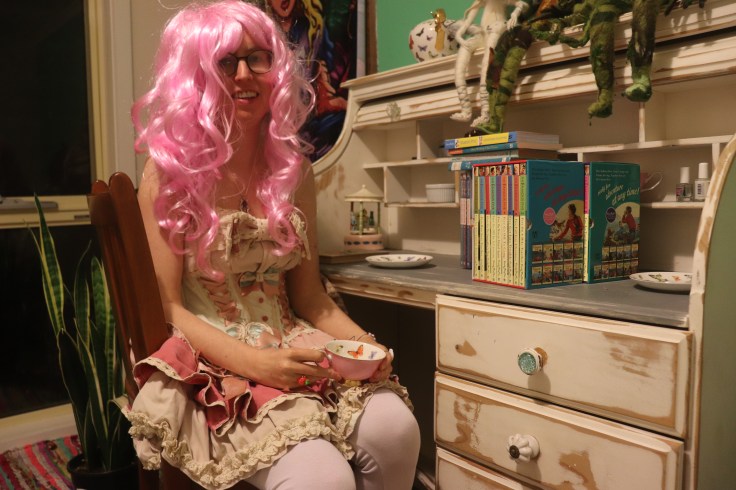
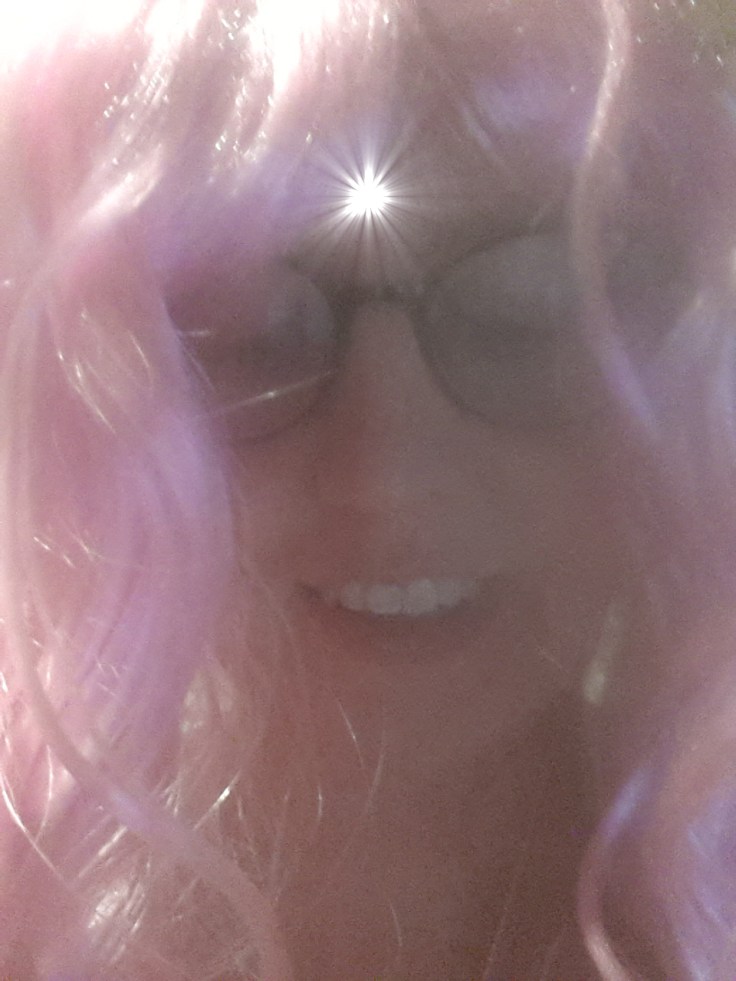
Other days I feel like this:
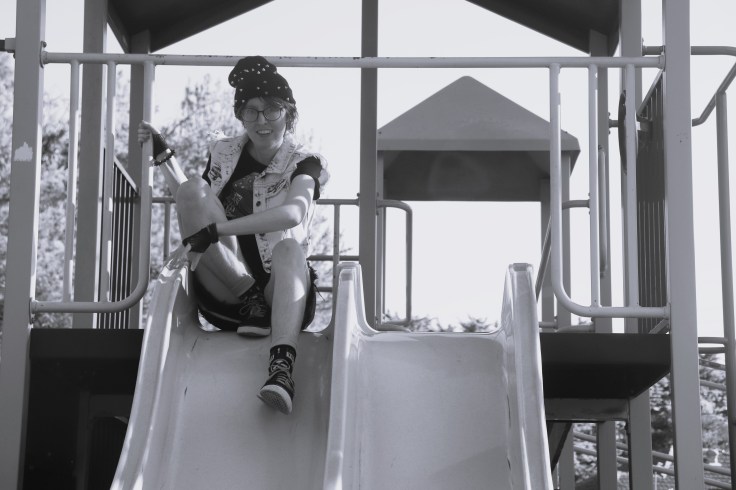
While I find the switches get more extreme under extreme stress, I have pretty much always been this way. I have pictures of myself as a kid where I very much looked like a little boy. I usually preferred to wear shorts, pants and boots or boyish sandals. My interests were gender-neural. I was never into dolls, except when I took to turning Barbie goth with a black marker. Then there are pictures where I look extremely girly. I wore dresses and experimented with lip gloss. Often I would combine the two where I had a traditionally feminine hairstyle but a masculine attire.
My favourite colours as a child were pink, blue and yellow, perhaps representative of my different genders: feminine, masculine, and gender-neutral.
I put some of my gender identity down to astrology. A unique feature to my astrology chart is the way the sun (in free-spirit Sagittarius) is directly opposite the moon (in Gemini). This, it turns out, means that I was born on full moon, when two competing and equally powerful influences (sun and moon) are present. It’s as though there’s this inherent polarity in my life. I have often written about being torn between opposing desires, needs, and orientations, and gender is just another expression of that. The challenge for Full Mooners is reconciling the very different aspects of their personality. I need to find a place for all in my life and avoid duality. To add to things, my sun, moon and even Ascendent signs are all “mutable” signs, which are known for their everchanging nature.
I will now move on to a new pronoun I have started identifying with: “it”. On the surface, it may seem strange, and a lot of people wonder why those of us would use it. Some even find it offensive as it’s been used to dehumanise trans people, but it’s important to remember that ALL pronouns have been used to dehumanise and delegitimise trans people. As “Grey” on reddit reminds us, “Calling a trans woman “he” is belittling, horrible, and delegitimizing. However, “he” is still a valid pronoun to use if it suits you, because it is not the pronoun itself that is bad, but the way the person is using it and the intentions they are using it with.”
I am well aware that people will probably refuse to call me “it” as it’s uncommon and they don’t want to refer to me as an “object”. I am well aware that I am likely to be laughed at by a lot of people if I start using this pronoun. I must admit, I find it hard to keep a straight face at times too. The first person I told about my new pronoun was my therapist.
“To be completely honest, I am not sure whether you are joking or serious, Zoe?” I wrote back to me. “I am sorry if you are serious and that offends you, it is just your mischievous sense of humour that puts me in two minds”
“Haha, to be honest I am not quite sure either!” I wrote back. “I’m half joking, but half serious as well. I know it sounds pretty funny and maybe a little insane when people realise you’re actually serious, but the more I read from those who use these pronouns, the more I want to use them too. But can you just imagine the looks on the cops’ faces if they ever come to my house again looking for me and my dad answers the door and tells them “it’s in it’s room”. They’ll seriously be thinking what the fuck is wrong with these hospitals? They need to lock this girl away and throw away the key”
No body should have to justify their pronouns to anyone. At the end of the day I identify with the pronoun “it” for the same reason as somebody identifies with the pronoun “he”, “she” etc. But I’d like to share some of those comments on a Reddit forum which may help people understand a little more where I am coming from. The comments are a response to a question someone posted asking why people use “it/its” pronouns here:
“I have a very hard time connecting with being human and find more comfort and being referred to as ‘it’ because it’s not a pronoun typically associated with humans. People usually use ‘it’ when talking about an object, animal, concept, creature, etc and that just makes me happy 🙂 /g” s42isrotting
“I use em bc I think they’re neat and feel nice, and also bc, for me, I already feel inhuman, yk? Sometimes it’s comforting to distance myself from the fact that I have a body, as weird as it seems.
For me and other ppl I know, it’s an embracement of dehumanization. Reclaiming the term. Because, well… I already don’t feel human bc of my dysphoria and other issues, so why not” FalseHeartbeat
“Right!? People are like “but it’s dehumanizing” and I’m like “yes, and?”
I don’t know why “human” is something to strive for. In general, humanity kinda sucks.
That said, i understand that “it” makes other people uncomfortable so i generally use “they” but secretly prefer “it”.
I just want to be a happy thing.” Ellisto
“It really depends on the person. I personally use it/its pronouns because I’ve been made to feel less than human because of various reasons and I decided to reclaim being called it so that others could no longer use it to hurt me. After using that pronoun set for a bit I found that I genuinely feel good when it is used in a non hostile way. It/it’s pronouns can also make people with certain gender identities feel more comfortable too, for example I’m genderfluid and one of the genders we’ll switch to is voidgender and they/it pronouns are what works best there” JustASock333
“I use they/he/it, and personally, it just feels right. It doesn’t really feel dehumanizing to me, I can’t really explain why. My friend also uses it/its pronouns, though I’ve never asked it why it uses that pronoun set. Said friend was actually the one that first introduced that pronouns set to me! I’m very grateful to it for that.
Also, I’m pretty sure I’m otherkin or something of that sort, so I don’t really know. That must get be part of the reason?” Amber-TheFanby
“for me it’s kinda a nice coping skill almost? it also helps me separate myself from… myself really. my body is an it you know? i am simply existing in an object and this object doesn’t define me. as i said it can also be a coping mechanism. in times of stress i really like it because it kinda makes me feel like i’m not there, i don’t have to worry so much. although it’s mostly the first one” splish-splash
“I personally use it/its pronouns along side they/them for two reasons
- They’re completely genderless, with no gender attached to them at all.
- I’m a therian and it/its pronouns make me feel better about my identity.
It’s obviously different for everyone, and I know people who use them to reclaim it/its pronouns, but this is just why I personally use them :]” King_Of_Forks
“
- “same reason anyone uses any pronouns i guess? they just feel nice to be reffered to as?
- because my gender is something along the lines of ‘horrid little magpie of a man’ and it/its fits me well
- its something of a rebellion against the norm. my gender is way too complicated to be sorted into boxes and frankly i got sick of ‘he/him for men, she/her for women, they/them for nonbinary people’ im not really any of those! im just a little creeture!
- other neopronouns just didnt fit me as well and also i sometimes struggle with getting them right whereas it/its is easy and means i dont have to think about it for a minute before using pronouns for myself
there are other reasons but those are the main ones. really all it boils down to is ‘i like using it/its and they feel as though they fit me” jasondoesstuff
“I prefer it’s/it pronounce because it makes me feel powerful, also when talking about myself i prefer to talk by third person as “Samuel don’t like that” instead of using first person, it’s just feel the best” semael237
“Honestly, I do something similar! My friend group likes to call me a plant, so its common for to go like “the plant no like that” randomly. Like just a few days ago I was like “it’s cold. The plant doesn’t like the cold.” Amber-TheFanbby
“Hi, I use it/its pronouns. The reason I use that is because I never grew up using it/its in a derogatory way. In my family it was always more a sign of affection lol, so nowadays I straight up use them as my official pronouns (next to she/her, but I do actually prefer it/its!)” CrystalyNova
“The only folks I know that use it, use every pronoun, and do it because they just don’t give a fuck what you call them. They don’t think of it as super important for their self identification” coralinehop
“I had a friend who preferred it pronouns for awhile. Not sure if it/they still do(es). They/it also was referred to as “The Ava” so it seemed appropriate when referring to them/it as a position.” erraticandlost
“I use it/it’s pronouns and honestly for me it comes down to not feeling “in my body” all the time. Like sometimes I identify with my body and other times I don’t so I use it/it’s then. Otherwise I use she/her. I don’t care if people use they/them for me.” cripplinganxietyImao
I also discovered a great YouTube video by somebody who uses it/its pronouns and is also autistic. I’m not surprised there is a relationship between the two. It talks about embracing being a “freak” through the use of it/its pronouns. The video can be watched here.
I don’t know if it’s a coincidence that this identification has come at a time where I find it unbearable being in my body because of the physical pain and discomfort I am constantly in. I find it interesting the Reddit comments that talk about this being a coping mechanism in some ways to distance ourselves from our body. I have also been part of otherkin communities for a while, and identify as a mythical humanoid and Lemurian starseed. I once had a woman in a spiritual group comment on my hands and their unusually long, thin fingers. As I said in another post, I keep wondering if the reason why doctors injure me is because I am not even human and have a different anatomy. I wonder whether I would have better luck at a vet’s! I think all this would make for a great fictional story, which could start at a vet clinic where, one evening, what appears to be a girl comes into the vet and asks the unsuspecting veterinarian for help. The veterinarian asks where the animal is, and the “girl” says she IS the animal.
I find “it” pronouns carry an air of mystery that I like. They remind me of the book “Five Children and It”. We call the things we don’t really know “it”. They also remind me of one of my favourite childhood shows, Pokemon, where Pokemon were always referred to as “it” while also being loved. Referring to something as “it” doesn’t mean we don’t care about it. As one of the Reddit comments said, “it” pronouns was used as a sign of affection in its family.
I am already becoming less and less of what makes someone a human. A few months ago I stopped speaking. I don’t know what people are going to make of me if I start asking them to use “it” pronouns with me now. My life seems to be defined by lack: I am asexual, I no longer speak, and with “it” pronouns I am not just agender but also not even really human. I don’t know whether this is some kind of expression, representation and embodiment of being treated like an alien all my life and not being heard. Why bother talking when no body listens anyway? It reminds me of Shilina-Conte’s piece, “Silence as Elective Mutism in Minor Cinema“, where they talk about Elisabet, who has suddenly stopped speaking. Shilina-Conte talks about the character’s “nihilism” and “renunciation of a fraught modern world”:
“In Persona, the actress Elisabet Vogler is struck mute in the middle of a performance of the Greek tragedy, Electra. Elisabet is moved to an isolated summer cottage on the coast of Sweden, as the war in Vietnam rages, and with the pall of the Holocaust and failed maternity upon her. There she is cared for by Alma (Bibi Andersson), a forthright and talkative nurse. But as Elisabet’s psychiatrist observes, she is not physiologically incapable of speech. Her traumatic aphasia is her negative critique of what the doctor diagnoses as “the hopeless dream to be”. She rejects any kind of identity-forming role performed in a social sphere such as mother, wife, or actress, in opposition to the domination of the subject by society. This non-identity is implicated only in the negative: “No” and “Nothing” are Elisabet’s only spoken words in the film. Alma uses multiple coercion tactics to elicit speech from Elisabet; threatened with a pot of boiling water from the stove, at the apex of their quarrel over Elisabet’s betrayal of Alma’s confidences, the actress screams, “No”. As Elisabet’s futile treatment draws to a close, she is commanded by Alma to “Say ‘Nothing’”. Elisabet claims non-identity and non-sense as the only possible expression of untruth. Her “no” and “nothing” not only echo the sentiment, “Never again”, but also offer the counterpoise that is the autonomy of art. “Elective mutism” in Persona is thus linked to fragmentation, discontinuity, and visual dissonance as a means of expression, which is emblematic of the critical status of art that refuses to participate in representing or reproducing totalities. Such “elective mutism” at the centre of the film produces the symptomatology of objectification, the alienation of the subject, and the unfreedom of the individual in the social structure.”
The article also examines other mute characters in cinema whose lives have been defined by nothingness, lack, loss, and statelessness, such as Suleiman who is a man without a country.
Shilina-Conte talks about elective mutism as an act of resistance:
“A willful refusal to speak can acquire the positive connotation of electing silence as a form of protest and defiance in the face of the intolerable. Those who practice a resistant silence occupy the position of a mindful observer, as opposed to a speechless victim – a process that is paradoxically affirmative.”
 hsphaven
February 6, 2025 at 12:59 am
It makes sense to want to identify otherwise. I have thought about this before mainly because of my dislike of being labelled and I have always needed freedom of expression. I am not like other people either in many ways (even from the neurodivergent groups) and a very recent brain scan reveals a very interesting case. I will try and refer to you as ‘it’, though I find habits hard to break.
LikeLiked by 1 person